
Behind the Scenes: How We Create Our Unique Role Plays
By Melissa Reinberg, Negotiation Works Founder and Executive Director
The assigned role plays in the negotiation course I took in law school focused on soccer stars, opera singers, and law book sales. These were useful vehicles for learning the negotiation concepts we were being taught, but as an aspiring public interest lawyer, I didn’t easily relate to the fact patterns—they just had very little to do with what I envisioned as my future legal practice.
Fast forward about thirty years.
As I set out to create Negotiation Works, I knew I wanted a defining feature distinguishing our curriculum from negotiation programs taught in academic and executive settings to be our use of role plays and scenarios targeted to our community members. I intended to generate role plays that would grab the students’ attention, draw them into the stories, and help them see how the abstract concepts we were teaching applied to situations they faced in their everyday lives. I also knew that crafting customized role plays specifically for the individuals each of our community partners served would result in a better and more effective learning experience.
Between 2016—when I first developed a series of negotiation classes for the women at Calvary Women Services—and now, we have created over fifty role plays covering a broad range of everyday conflicts involving family, employment, housing, health, education, and other common situations. We design these role plays to use in classes for women experiencing homelessness, domestic violence survivors, people currently incarcerated or recently returned from incarceration, individuals at risk of involvement with gun violence, older teens who identify as LGBTQ+, and many other historically marginalized groups.
So how do we craft customized role plays for each of these communities and ensure they are engaging, relatable, and relevant to the students’ lives?
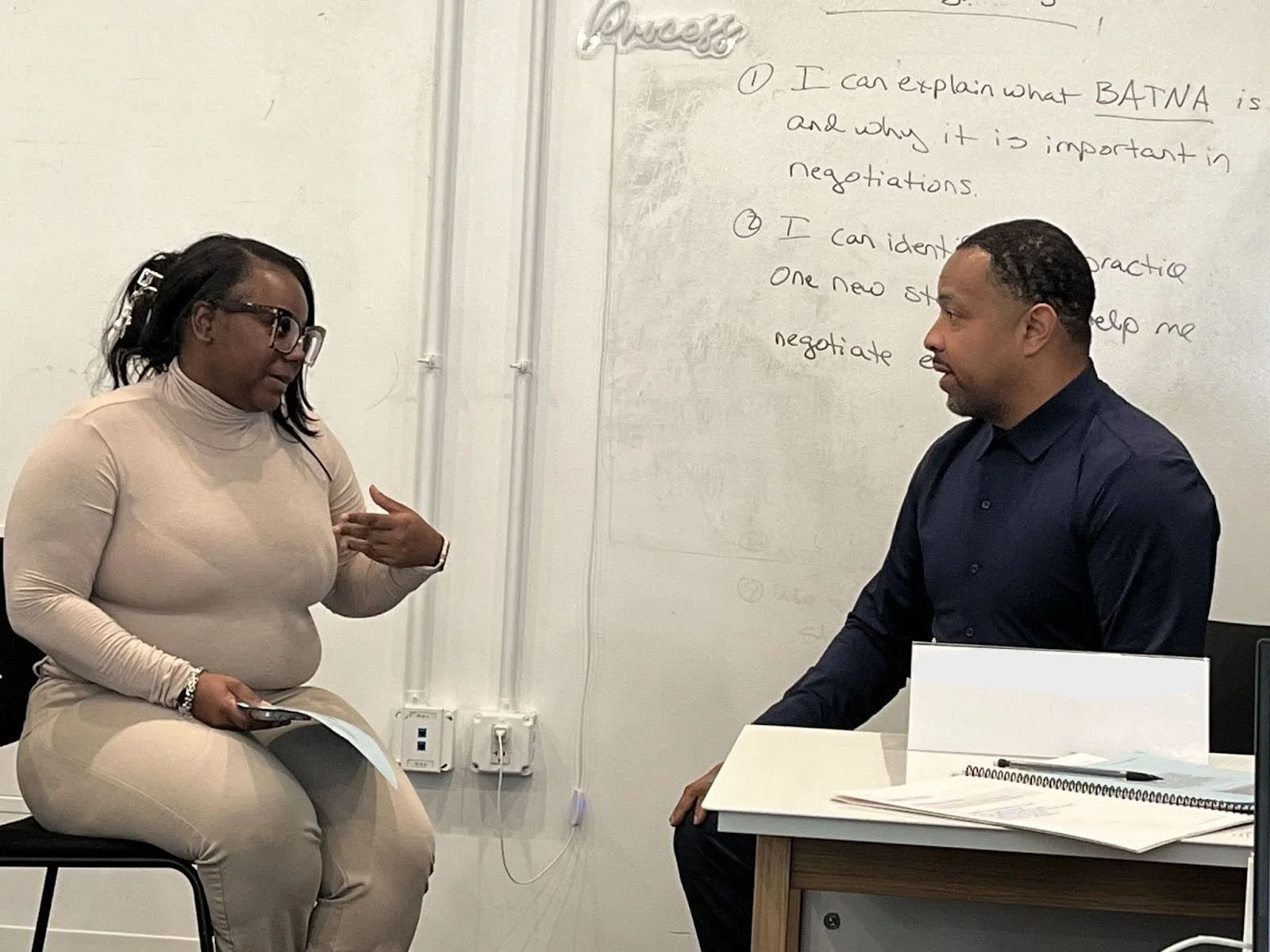
Georgetown Pivot Fellows role play scenarios weekly as part of their negotiation course.
The most critical component of this process is to accurately identify common and recurring issues our participants experience. In every course, we listen as our students describe various challenges they face in their current life situations, such as managing tensions with co-workers, sharing childcare responsibilities with the other parent, and navigating the health care system to secure much needed medical appointments. We also hold focus groups with our Ambassadors to seek their insights. For example, when crafting a negotiation workshop for teens, we asked the Ambassadors for ideas of common, recurring scenarios teenagers face, and they recounted challenging situations involving peer pressure, parental rules, and dating. More recently, we facilitated a discussion among the Ambassadors about the many barriers justice-involved individuals experience when seeking to create, maintain, and rebuild relationships with family members--particularly their children--during and after incarceration.
We also learn about concerns salient to community members by taking part in issue-focused coalitions such as the Reentry Action Network. This group meets regularly to offer its members–nonprofit organizations that provide reentry services to justice-involved DC residents—a platform to share experiences, challenges, and ideas for addressing the complex needs of individuals in the DC area who have been incarcerated. Hearing these collective voices further guides our development of role play content.

Class participants at Urban Ed join in a role play.
Our community partners also provide critical input we use to craft our role plays to best meet the needs of their clients and constituents. Partner staff, for example, have told us their clients would benefit from practicing workplace negotiations such as seeking a raise, asking for a schedule change to accommodate medical appointments, or working with co-workers on group projects, and we developed role plays that fit these fact patterns. Perhaps more important, as part of our commitment to provide trauma-informed services, we regularly discuss with our community partners whether any issues in our existing repertoire of role plays might be too sensitive or traumatic for their current client base.
Once we’re ready to write a role play, we synthesize all this information into a storyline that contains a rich complexity of facts, nuanced so as not to suggest a singular resolution to the conflict. We develop two “sides” of the story, while also making sure the facts are balanced and realistic. Within every role play, we embed negotiation concepts and themes (for example, developing creative options or negotiating with a weak BATNA) that correlate with the focus of our lessons. Rounding out each role play are comprehensive teaching notes for the instructors with background information and step-by-step guidance for preparing, conducting, and debriefing the exercise.
We then canvas our staff, partners, and volunteers, soliciting feedback about the fact patterns and the conflict dynamics embedded within them. We also occasionally do trial runs of the role plays with our Ambassadors, who help us identify unrealistic or confusing aspects of the exercises.
Once we have made any suggested adjustments, we are ready to try the new role play in a class. But the work is still not done. After our instructors run the new exercise with a full class, we ask them to share what worked and what didn’t work and to describe the participants’ responses to the exercise. We then modify the exercises accordingly.
Through this collective, community-focused process, we develop and shape our negotiation exercises to best support both our teaching goals and the participants’ needs. The result? We have a rich and unique library of materials that can reach a broad range of populations from historically marginalized communities with customized, tested courses that provide essential life skills. We look forward to continuing adding to this collection and increasing access to the self-advocacy and conflict resolution training that gives everyone an equitable shot at building stable and successful lives for themselves, their families, and the broader community.
We are now licensing several of our role plays and scenarios through the Dispute Resolution Research Center (DRRC) at Northwestern University’s Kellogg School of Management for educators, fellow nonprofits, and other entities that serve a variety of groups who could benefit from our unique negotiation skills training model. Check out the Dispute Resolution Research Center’s website and search for “Melissa Reinberg” in the Teaching Catalog to locate our role plays.