
New Results: Gender Differences in Participant Outcomes
By Melissa Reinberg, Negotiation Works Executive Director
Graphics by Drea Cabral, 2026 Negotiation Works Intern and Class of 2028 at Yale College
Over the ten years that Negotiation Works has taught classes to underserved groups across the Washington, DC metropolitan area, class participants have consistently reported negotiating more effectively and with greater confidence after they completed our course. In evaluating our impact during 2025, our data team examined, for the first time, how these changes differ among male and female participants. While reaffirming previous findings regarding overall improvement in negotiating skills, the team’s most recent work offers new gender-specific insights into the impact of our courses, suggesting promising avenues for further refinement of our data along with potential adjustments in our curriculum.
Who We Teach: Class Participants
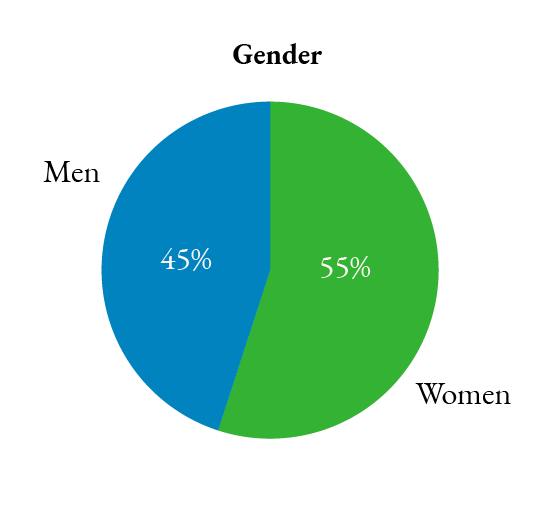
The 258 participants in our 2025 programs were split by gender 55% women/45% men. We taught at five community organizations plus the DC Jail, where we led classes in eight distinct units. Broken down by program, the participants at Calvary Women’s Services, Reach Up, and Together We Bake are all women, while our returning citizen programs at the Georgetown Pivot Program and the MORCA-Georgetown Paralegal Program are mixed gender but primarily men. Our classes at the DC Jail are split evenly between men’s units and women’s units.
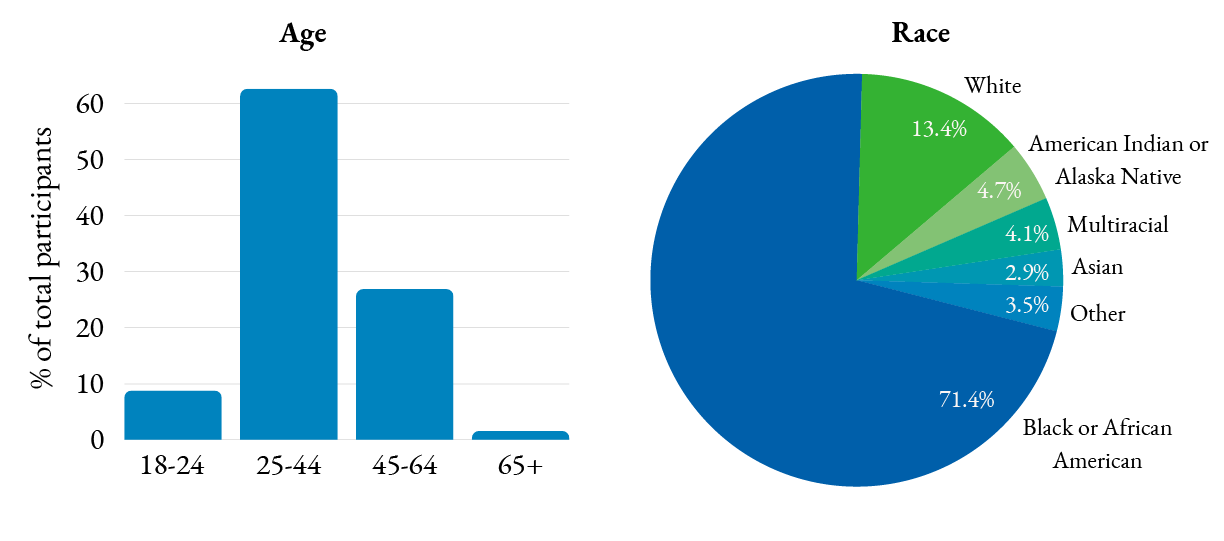
Additional demographic data—reflected in the accompanying graphic—indicates that more than 60% of our participants fell into the 25- to 44-year-old range and more than 71% were Black or African-American. Nearly 70% of participants reported their highest level of education as a high school diploma (or equivalent) or some college without earning a degree.
Methodology
We collect information and feedback about the classes we teach through multiple surveys administered before, during, and after the courses. This data helps us understand our participants’ needs, the ways in which they apply negotiation strategies beyond the classroom, and their comfort and confidence in negotiating across various contexts.
Two sets of changes we measure from pre-course to post-course are participants' level of confidence in handling difficult interpersonal situations and their “go-to” style when responding to specific conflicts. Analyzing these data together suggest somewhat nuanced differences in how men and women approach conflict before and after taking part in our courses.
Changes in Confidence Level
After the course, participants became more confident in their negotiating ability, with greater gains in the female populations. Sixty-one percent of the women and 42% of the men reported post-program an increase in confidence to self-advocate for their needs; and 58% of the women and 40% of the men reported post-program an increase in confidence to manage conflicts productively.
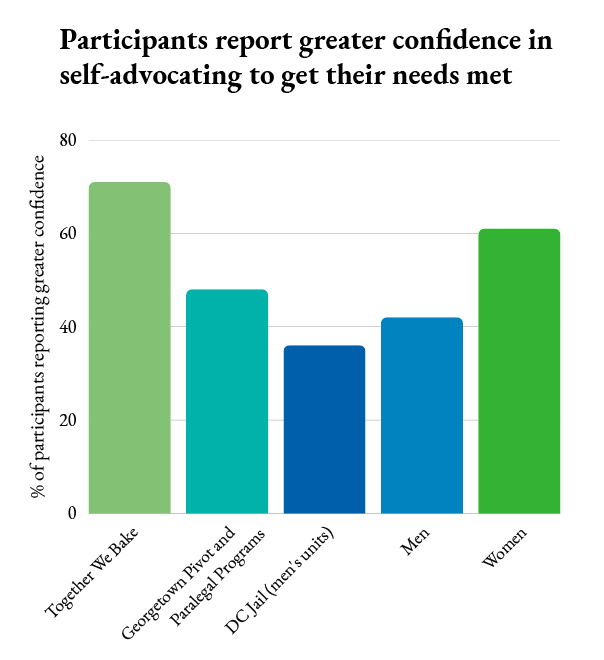
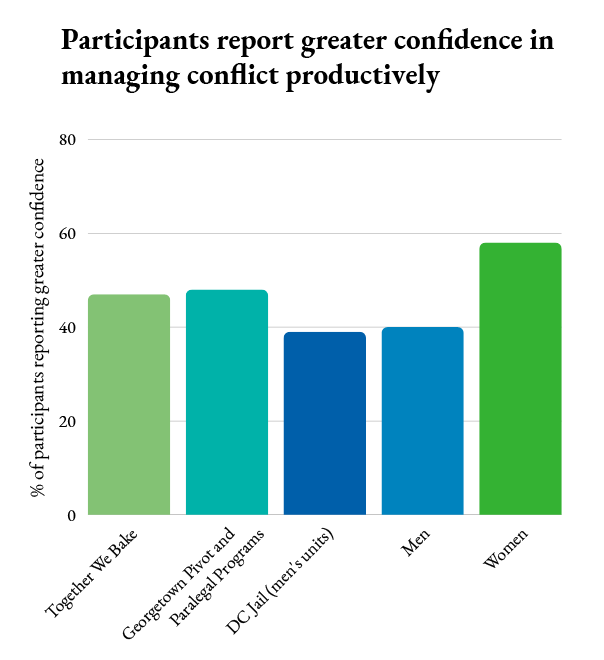
The sharper increases seen among the female participants as compared to the male participants could be due to a variety of factors. For one, the women in our programs began the course with a lower self-rating in confidence compared to the men, giving them greater opportunities for growth over the course of the program. Other factors—such as group dynamics, complementary programs offered at our sites that serve women, or differences in participant characteristics—might also have contributed to these results.
Changes in Negotiating Style
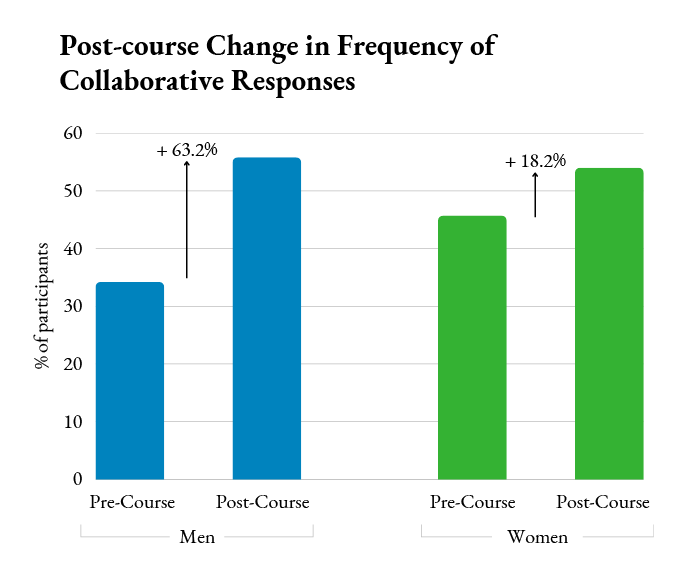
We measure negotiation style by asking participants to respond to two conflict scenarios–one involving a family dispute and another involving a landlord-tenant dispute. We examine three negotiation approaches within the participants' responses: collaborative, competing, and avoidant. After taking our classes, both men and women showed movement toward greater use of collaborative strategies in addressing these conflicts. Digging into the data by gender and context paints a more nuanced picture and reveals distinctions across both factors.
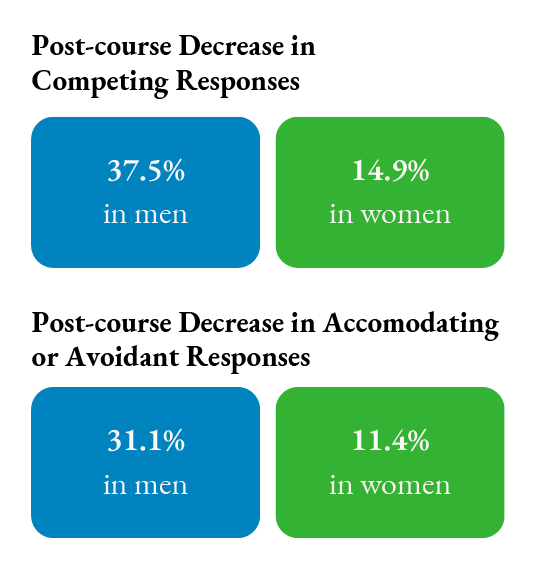
In the family context (shown in the accompanying graphic), participants demonstrated a shift in response patterns toward collaborative engagement and effective self-advocacy. Changes among male participants were pronounced across all three strategies: a 63% increase in the use of collaborative approaches, a 37.5% decrease in competing behaviors, and a 31% decrease in avoidant behaviors. Female participants’ responses to this interpersonal conflict also showed meaningful, though somewhat more modest, changes across all three measures: an 18% increase in collaboration, a 15% decrease in competing, and an 11% decrease in avoidant responses.
Responses to the landlord-tenant dispute (not depicted in the accompanying graphics) also showed participants with measurable shifts toward collaborative approaches. Looking by gender, however, revealed interesting distinctions. Once again, the shift in male participants’ use of a collaborative approach was clear and pronounced, with a 36% increase, accompanied by a meaningful decrease (21%) in competing strategies and minimal change in avoidant strategies. By comparison, female participants demonstrated only a slight increase in collaboration (6% increase) but alongside a sharp reduction in avoidant responses (40% decrease) and, somewhat surprisingly, a significant increase (23%) in competing approaches, suggesting a shift toward assertiveness that did not consistently align with collaborative approaches.
Insights we can we draw from these findings
Overall, these findings suggest that post-course, participants are increasingly engaging more confidently in collaborative conflict resolution and demonstrating stronger self-advocacy skills across interpersonal and structural contexts, albeit with some observed differences by gender.
The largest decreases among the male participants were in the use of competitive strategies, which declined by 37.5% in the family context and 21% in the landlord-tenant context. The family scenario was particularly revealing, with men demonstrating more pronounced increases in collaborative strategies and larger decreases in both competing and avoidant strategies than women. These findings suggest that the program's emphasis on developing negotiation skills for managing contentious situations, such as the family scenario, may have been particularly beneficial for male participants. Coupled with their increased post-program confidence, the men’s reduced tendency to approach conflict adversarially and increased tendency to adopt collaborative approaches suggest that male participants may have felt better equipped to address disputes constructively after completing the course.
By comparison, after the course, female participants reported a reduced reliance on avoidance as a strategy for dealing with conflict (a 40% decrease in the landlord-tenant scenario and an 11% decrease in the family scenario), along with greater use of collaborative and, in the landlord-tenant context, competitive approaches. Although the increased use of competitive responses in the landlord-tenant scenario warrants further examination to better understand the specific strategies involved, these findings, together with female participants’ greater confidence in their ability to self-advocate and solve problems, suggest that the women may have felt better prepared after completing the course to engage directly with conflict rather than avoid it.
How we use these findings to improve our curriculum
While these initial results are informative, we plan to analyze larger datasets by gender before drawing more definitive conclusions. In the meantime, we use these trends to help guide the ongoing refinement of our curriculum. For example, we might develop role-plays for female participants that provide additional opportunities for addressing conflicts head-on, particularly in situations involving people in a position of authority, such as landlords or supervisors. Likewise, we might create scenarios for male participants involving highly charged interpersonal conflicts—such as disputes over money loaned to a friend or restrictions on child visitation—to give them more opportunities to practice resolving tense situations collaboratively rather than adversarially.
As we continue to collect and analyze evaluation data, we deepen our understanding of how participants' needs differ by gender, program site, and other demographic characteristics. These findings help us better customize our curriculum for the groups we serve by guiding the development of more relevant, realistic role plays and helping our instructors tailor their approach to participants' needs.
Special thanks to all on our data collection and analysis teams for sifting through this data and to summer intern Drea Cabral for putting together these graphics.